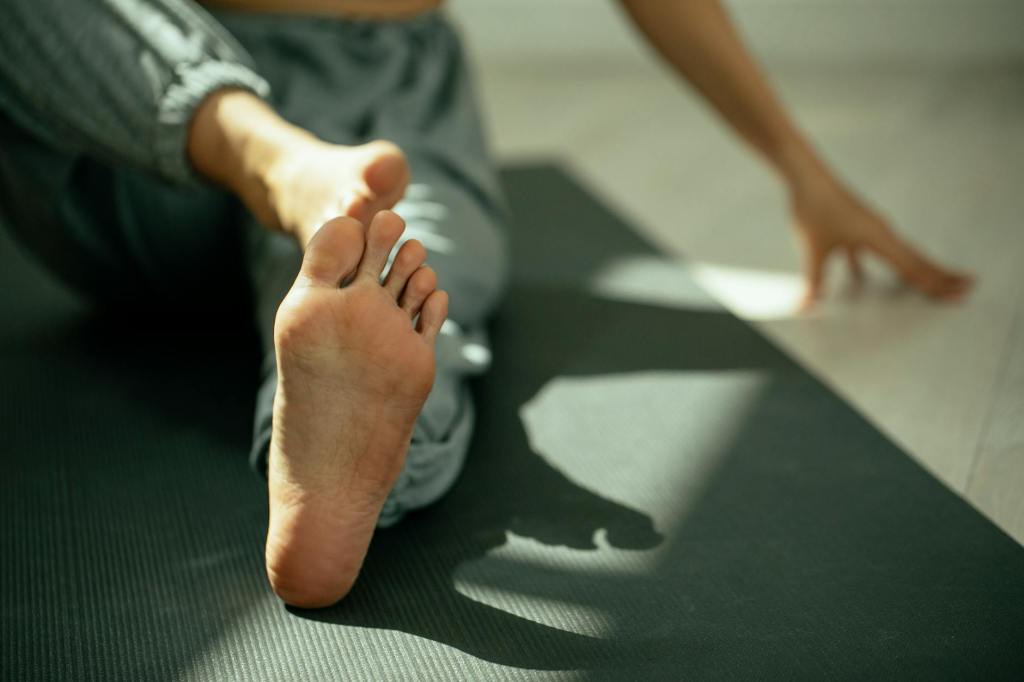
Have you ever wondered why we practice yoga barefoot?
Few weeks ago I came upon a very interesting article about it and it inspired me to share this info with you. Some of the things were quite obvious to me, but some information were quite new. Now I wonder: have you ever thought about it? Did you know the science and traditions behind it?
Read on to discover throughout this text why beeing barefoot in yoga is more than just comfort.
When you step onto a yoga mat, something quietly powerful begins and it starts from the ground up. Thus you take off our shoes before the practice not just because it’s tradition or for comfort, but because being barefoot is intentional here. It’s rooted in physiology, neurology and the profound mind-body connection. So let’s begin to explore why yoga starts with your feet and why that’s a very good thing. And feel free to share also some of your insights, experiences or thougths in the comments below.
Your feet is the foundation of the entire body
Did you know that your feet are architectural marvels? Each foot has 26 bones, 33 joints and over 100 muscles, tendons and ligaments, that are working together to provide balance, mobility and shock absorption. That’s 25% of all bones in your body – just in your feet! Yet in our modern world, feet are often neglected. They crammed into narrow shoes, disconnected from natural surfaces and barely used for the full range of motion they’re designed for. In yoga, we reverse that. We reconnect with the body and its parts. We restore function and awareness.
The science-based benefits of barefoot yoga practice
1. Improved balance and proprioception
Beeing barefoot, the proprioceptors (sensory receptors in your feet and joints) get direct feedback from the ground. This feedback is crucial for balance, posture and spatial awareness. Shoes dull this connection, but barefoot yoga definetely helps wake it up.
Studies show that practicing barefoot improves postural control and reduces the risk of falls, particularly in older adults. (Ref: Journal of Strength & Conditioning Research, 2015)
2. Stronger intrinsic foot muscles
Modern shoes often weaken the small stabilizing muscles in our feet. Practicing yoga barefoot recruits and strengthens these intrinsic muscles, promoting healthier foot arches and reducing the risk of conditions like plantar fasciitis or flat feet.
Research in the “International Journal of Sports Medicine” (2016) found that barefoot training significantly improves foot muscle strength and stability.
3. Reflexology and nervous system stimulation
Reflexology teaches us that every part of the foot corresponds to a different area of the body, starting from the spine to internal organs. While yoga doesn’t follow reflexology explicitly, barefoot practice stimulates thousands of nerve endings in the soles, enhancing parasympathetic nervous system activity (our rest-and-digest state).
Foot stimulation increases vagal tone, which is linked to lower stress levels, better emotional regulation, and heart rate variability – a key marker of well-being.
4. Myofascial release and grounding
Fascia known as the connective tissue wrapping muscles and organs, runs in continuous chains throughout the body. The Superficial back line starts under your toes and connects all the way up to your forehead. Barefoot contact with the mat allows for subtle myofascial release and deeper connection through these lines, especially during standing poses, folds and transitions.
Unlocking tension in the feet can reduce back pain, release tight hamstrings, and even affect posture and breath. (Ref: Thomas Myers, “Anatomy Trains”)
5. Earthing (grounding) effects
Some theories (what is still debated in science but widely explored in wellness) suggest that direct contact with the earth – or natural surfaces – helps regulate inflammation and circadian rhythms via electron exchange with the ground. While your yoga mat may not be pure soil, especially outdoors the practice of grounding brings an energetic and calming element to the body, often enhancing mindfulness and presence.
Yoga and feet as a deeper connection
In yoga, the feet do more than hold just us. They actually anchor us into the present moment. They are engaged in every standing pose, from Warrior II to Tree Pose. They connect you to the floor in Downward Dog and many more.
Basically, your feet reflect your nervous system, your grounding and your ability to feel steady: emotionally and physically. When you move barefoot, your practice becomes more somatic, more embodied. You’re not just “doing” yoga. You’re inhabiting it. And from a teaching point of view? Cueing awareness into the feet brings new depth to even the simplest postures.
Thus this ritual of stepping barefoot onto the mat is very important.
Taking off your shoes is more than just a habit.
It’s a ritual of presence.
It signals your nervous system: “I’m here now.”
It says: “This is a space for reconnection.”
It allows you to feel more, to move more freely and to listen inward.
That is why no matter if you’re stepping onto your mat indoors or outdoors, for an energizing Hatha flow or a slow Yin session, that barefoot moment matters.
And now, are you ready to practice barefoot, on purpose?
Explore this connection in my weekly classes:
- Outdoor Hatha Yoga (weekends in Glattpark)
- Online Rebound Hatha Yoga
- Midweek Yin Yoga (on-site in studio)
Come exactly as you are. No fancy gear is needed, just your feet and your breath. You will find the link to the booking system under https://yinflowzh.com/yoga-group-classes/.
Also subscribe to my newsletter for mindful movement tips, event updates and inspiration grounded in body & science. And don’t forget to follow me on Instagram @_yin.flow_ for more real talk on movement, mindfulness, relaxation and recovery.







Leave a Reply