A seasonally aligned approach to movement, rest and energy
Maybe you have already read my previous post about When life begins to green again: the subtle intelligence of spring awakening (click here to read if not done yet), then you know that spring actually begins to appear quietly and almost imperceptibly. The light shifts slowly, then the air starts to soften. Something subtle begins to stir beneath the surface of the earth. And if we are paying enough attention, we are able to notice that the same is happening within the body. After the inward, slower rhythm of winter, the body does not suddenly become energetic, open or ready to move fully. Instead, it wakes up gradually. There is a return of energy, yes, but also a lingering heaviness, a softness, a need for patience. And this in-between state is where yoga becomes especially meaningful.
Honoring the transition
In many modern approaches to movement, spring is treated as a time to “get back into it” – to move more, do more, rebuild strength quickly. But the body does not respond well to sudden demands after a season of rest. In yoga, we understand that transition is part of the practice.
Spring is not a sharp turn from stillness into intensity, but rather a bridge – a gradual shift from inward to outward, from quiet to expression, from rest to movement. And like any transition, it requires awareness.
The energy of spring: rising and expanding
In TCM (Traditional Chinese Medicine), spring is governed by the Wood element, which carries the quality of growth, expansion and upward movement. You can see this energy everywhere in nature: plants pushing through the soil, trees reaching upward, life expanding toward light.
In the body, this same movement begins to appear as a desire to stretch, to open, to breathe more deeply. Energetically, this rising quality is also reflected in yoga through Udana Vayu – the upward-moving current of prana associated with the chest, throat and head. It supports expression, clarity and a sense of lightness. But upward energy needs space to move, too. If the body is still holding winter’s tension – especially in the hips, inner legs and sides of the body – this natural expansion can feel blocked or uncomfortable. This is why spring practice is not about forcing movement, but about creating pathways for energy to flow again.
Yin Yoga: creating space for movement
Yin yoga plays an essential role in this seasonal transition.
While spring invites more activity, the body still benefits from the slow, sustained opening that yin provides. In fact, without this preparation, movement can feel restricted or forced.
As you already know, in Traditional Chinese Medicine, the Wood element is connected to the liver and gallbladder meridians, which run through the inner and outer legs, hips and sides of the body. These areas often hold tension – physically and emotionally – especially when energy becomes stagnant. However, Yin poses that target these pathways can gently release that stagnation.
Key Yin poses for spring
Bananasana (side body stretch)
This pose opens the lateral line of the body and stimulates the gallbladder meridian. It creates space for breath and encourages a subtle sense of expansion.
Sleeping Swan (yin pigeon)
A deep hip opener that works into the outer hips and glutes, helping to release stored tension and emotional holding.
Shoelace with side bend
This combination of hip opening and lateral stretch accesses both liver and gallbladder lines, inviting both grounding and expansion.
Dangling (forward fold or squat variation)
Encourages a gentle release through the spine and inner legs, supporting the flow of energy through the liver meridian.
In all of these poses, we are not trying to achieve intensity, but allowing time and gravity to do the work. The effect is subtle but powerful: the body softens, space is created and energy begins to move more freely.
Hatha yoga: reintroducing movement
As space is created through yin, the body becomes more receptive to active movement. This is where hatha yoga enters the picture – not as a contrast to yin, but as a natural continuation.
Hatha in spring is about reawakening strength, coordination and breath awareness in a gradual and intelligent way, instead of pushing into peak performance directly.
Qualities of a spring Hatha practice
- Slow, mindful transitions
- Emphasis on breath-led movement
- Gentle activation rather than intensity
- Spaciousness between poses
The aim is to invite energy to circulate, not to exhaust it.
Key Hatha poses for spring
Cat–Cow (spinal awakening)
One of the simplest and most effective ways to reintroduce movement into the body. It awakens the spine and connects breath with motion.
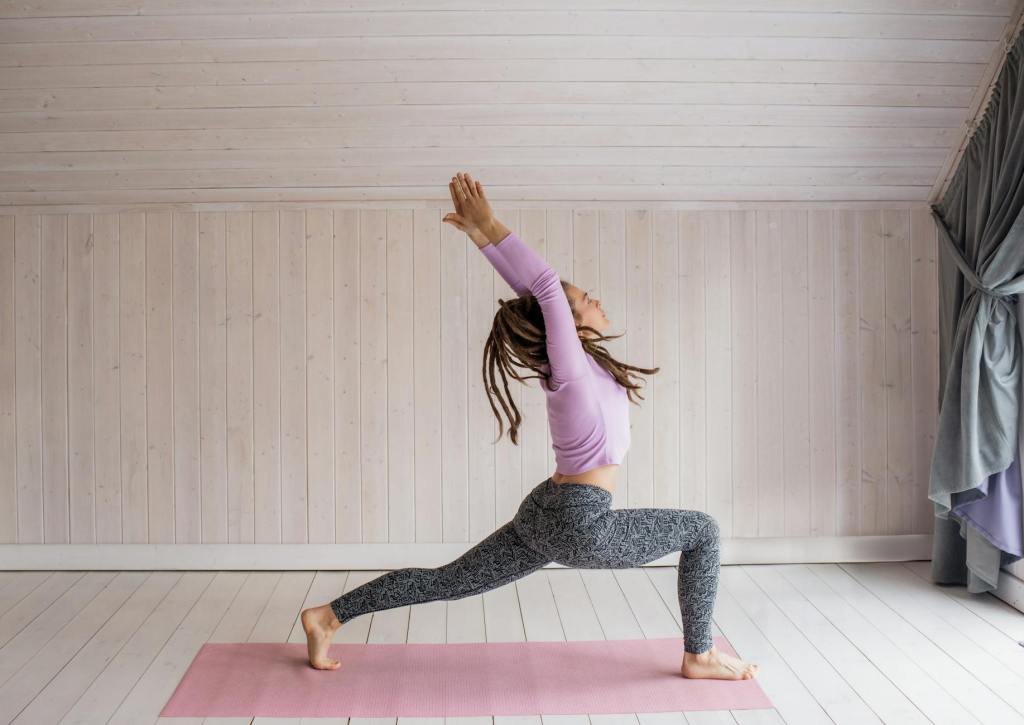
Low Lunge (Anjaneyasana)
Opens the hip flexors and front body while encouraging an upward lift through the chest – mirroring the rising energy of spring.
Twists (gentle seated or standing)
Support detoxification and stimulate the digestive and energetic systems connected to the liver.
Sun Salutations (slow and mindful)
Rather than fast-paced flows, slow sun salutations help rebuild warmth, coordination and breath awareness.
Heart-opening postures (Cobra, Sphinx, gentle backbends)
Encourage a subtle lift through the chest and throat, supporting Udana Vayu and the expression of upward energy.
Movement as a dialogue with the body
Perhaps the most important shift in spring practice is not what we do, but how we do it. Movement becomes a conversation rather than a command.
Instead of asking, “How far can I go?”, we should begin to ask, “What is my body ready for today?”. On some days the answer will be: more movement. On other days it will still be: a little more rest. Both are part of the process of waking up and that’s totally fine.
Balancing Yin and Yang
Spring is a season of increasing yang energy: movement, activity, expansion. However this yang energy grows out of yin. Without the grounding, nourishing qualities of yin, yang becomes unstable. It turns into restlessness, tension or burnout. That’s why a balanced spring practice honors both: yin that creates space and yang that moves energy. Together, they support a body that feels both open and alive.
Returning to aliveness
As the spring season slowly unfolds, something begins to shift more clearly.
The body feels lighter.
Movement becomes more fluid.
Breath deepens naturally.
This is not something we should force, but simply something we should allow.
Yoga, in this sense, is about remembering its natural rhythm. And spring reminds us that aliveness is already there. It simply needed time, space and attention to return. And sometimes, that return begins with something very simple:
A stretch.
A breath.
A small movement toward light.
If you feel like exploring this transition in energies and practicing this spring together, you’re warmly welcome to join me in my classes. You’ll find my current schedule via the link HERE.





Leave a Reply