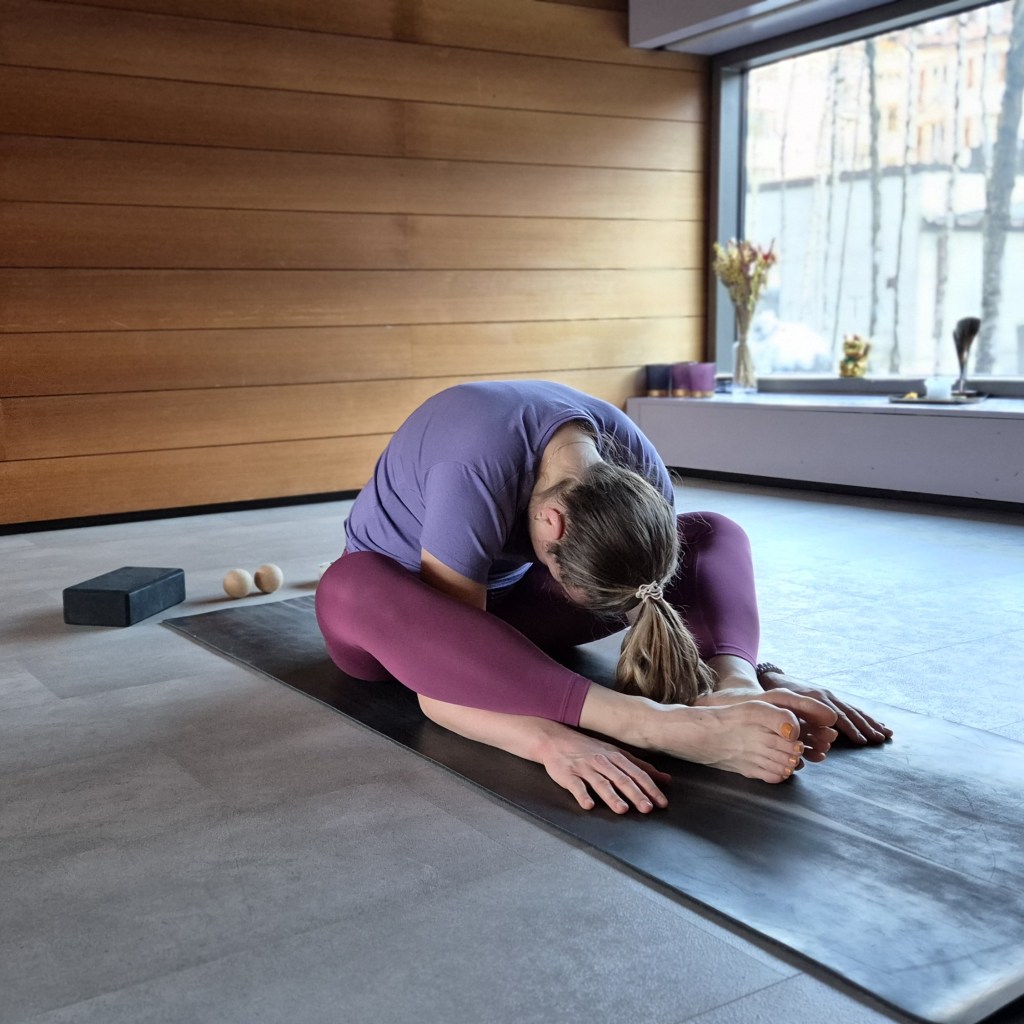
Quite recently a colleague of mine joined one of my outdoor yoga classes. Fast enough, it turned out that she is hypermobile and some poses felt different in her body, requiring a slightly different approach to alignment and support. There was nothing wrong with that, as we all know that bodies are wonderfully diverse and some naturally move with more ease than others. However, while hypermobility can make deep stretches and complex yoga shapes seem effortless and fun, it can also mask a lack of joint stability. So if your range of motion feels almost unlimited, shapes come easily and you’re very flexible, you should be more mindful in movement practices and do not to mistake flexibility for strength or control. Also read further my post to know more about this topic.
At first glance, ease of movement may appear to be an advantage in yoga, where mobility is often celebrated. Yet for some practitioners, this is not simply flexibility – it is actually hypermobility – a condition that changes the way the body experiences stability, effort and awareness. Instead of focusing on how far a pose can be taken, hypermobile practitioners often benefit from developing strength, proprioception and joint support. Their practice should be focused on stability within the movement that is already available, instead of increasing range of motion.
Several facts about hypermobility
Hypermobility exists on a spectrum: some people are naturally more mobile without experiencing any symptoms, while others may have Hypermobility Spectrum Disorders (HSD) or connective tissue conditions such as hypermobile Ehlers-Danlos Syndrome (hEDS). These conditions are related to differences in connective tissue, particularly collagen, which plays a key role in supporting ligaments, tendons and other structures throughout the body. When connective tissues are more elastic, joints may move beyond a typical range, sometimes without the same level of internal support or stability. Because of this, hypermobile bodies often experience a paradox: movement feels easy, but stability can be harder to access.
In a yoga context, this can be both beautiful and challenging. Yoga often encourage us into shapes that require openness, flexibility and surrender. For a hypermobile practitioner, these shapes may come naturally – sometimes even too naturally and what is often perceived as “progress” in yoga can occasionally disguise a lack of support. This is why awareness of how the body is supporting itself while it moves, becomes essential. And definetely one of the challenges for hypermobile practitioners is that yoga culture often rewards flexibility: deep backbends, impressive splits and extreme ranges of motion tend to attract attention and praise. And while there is nothing inherently wrong with these expressions of movement, they can unintentionally reinforce the idea that more range equals better practice. But over time, this can create a disconnection between what looks impressive and what actually feels sustainable. A healthy yoga practice encourages us to move beyond appearance and develop a deeper relationship with sensation, awareness and stability.
Why hypermobility requires special consideration in yoga
- Joint locking
Hypermobile practitioners often extend their elbows, knees or other joints beyond a neutral position. While this may feel stable, it often means relying on passive structures such as ligaments and connective tissue rather than active muscular support. Over time, this can place unnecessary stress on the joints and contribute to instability. - Reduced proprioception
Proprioception is the body’s ability to sense where it is in space. Many hypermobile individuals have a less reliable sense of joint position, making it easier to move beyond a safe range without noticing. This can increase the risk of overstretching and make precise alignment more challenging. - Overstressing connective tissue
Because hypermobile bodies often have access to a greater range of motion, there can be a temptation to continually move into the deepest expression of a pose. Repeatedly pushing into end range may place excessive stress on ligaments and connective tissues that are already more lax, potentially leading to discomfort, instability and injury over time.
This is why one of the most important aspects of practicing yoga with hypermobility is redefining what effort actually means. Effort is often associated with intensity, depth or visible achievement, but in a more embodied practice it can also mean restraint, control and internal support. Instead of moving deeper into a shape, the focus shifts to what holds the body together: stabilising muscles, steady breath and a nervous system that feels safe. This often requires slowing down and becoming more precise: simple standing poses, mindful transitions and foundational alignment often reveal far more than advanced shapes, so rather than chasing expression, the practice becomes about understanding structure. External support like props, mirrors or teacher feedback can be especially helpful here, as they support the development of clearer body awareness and a more reliable sense of orientation in space. Also strength, which in this context, is looking into sustainable muscular engagement that supports the joints without locking them. Gentle activation through the feet, core, shoulders and hips creates a stable base for movement. And when movement becomes unstable, breath often follows. Thus a steady breath brings organisation back into the system and helps movement feel more integrated over time.
How to adapt common yoga poses
Downward Dog
Instead of dropping into the joints, keep a soft micro-bend in the elbows and maintain active engagement through the arms. Press the hands firmly into the mat to awaken the upper back and create support through the shoulders rather than hanging in them.
Standing poses (e.g. Warrior II)
Avoid going too deep into the shape. Keep a sense of lift rather than collapse. A slight softness in the front knee and gentle engagement of the inner thighs can help build stability instead of relying on passive flexibility.
Forward folds
Keep a soft bend in the knees rather than locking them out. Let the spine stay supported instead of completely releasing into gravity. Using blocks under the hands can help maintain length in the spine and prevent overstretching in the lower back.
Plank / Chaturanga
Prioritise control over depth. Keep elbows slightly bent rather than hyperextended and actively press the floor away to engage the shoulders and core. Lower only as far as you can stay stable and supported.
Backbends (Cobra / Upward Dog)
Focus on length first, depth second. Keep the legs active and avoid collapsing into the lower back. Think of the lift coming from the upper back rather than dumping into the lumbar spine.
Seated poses (e.g. Butterfly / Forward fold seated)
Sit on a prop if needed to find upright alignment. Avoid rounding or collapsing forward just to reach the floor. Stability of the pelvis matters more than how far you can fold.
Supporting a safe and sustainable practice for hypermobile bodies
If you recognise yourself in this topic, the most supportive shift in yoga often begins with how you approach movement rather than what you do. Instead of prioritising depth or flexibility, the focus gently turns toward strength, control and awareness. And so here are the key things to know:
- Rather than passive or deeply yin-dominant approaches, a more supportive practice is often found in Hatha or strength-based Vinyasa, where engagement and stability are built gradually through conscious movement.
- In physical practice, it can be helpful to stay slightly before your maximum range of motion, rather than moving into the deepest expression of a pose. This allows the muscles to remain active and supportive, instead of the joints relying on passive structures for stability.
- Props such as blocks, straps or bolsters are not limitations, but valuable tools that create clear boundaries in space. They help prevent the joints from collapsing or “hanging” in end range, especially in positions where flexibility naturally exceeds stability.
- Equally important is communication. Letting your teacher know that you are hypermobile allows them to guide you toward engagement rather than depth, and to offer variations that support long-term joint health.
All in all, yoga in this sense, is not about becoming more flexible, but learning how to inhabit the body safely, intelligently and sustainably. Especially for those whose bodies already offer a large range of movement, the practice should be focused more on knowing when to stop and how to find support within what is already there. Over time, this will create subtle but profound relationship with the body that is less about performance and more about trust. And perhaps this is the deeper invitation of yoga for hypermobile practitioners: to discover that stability is not the opposite of freedom, but its foundation.
If you feel called to explore this in practice, you are welcome to join me in class. You can find my schedule HERE.







Leave a Reply