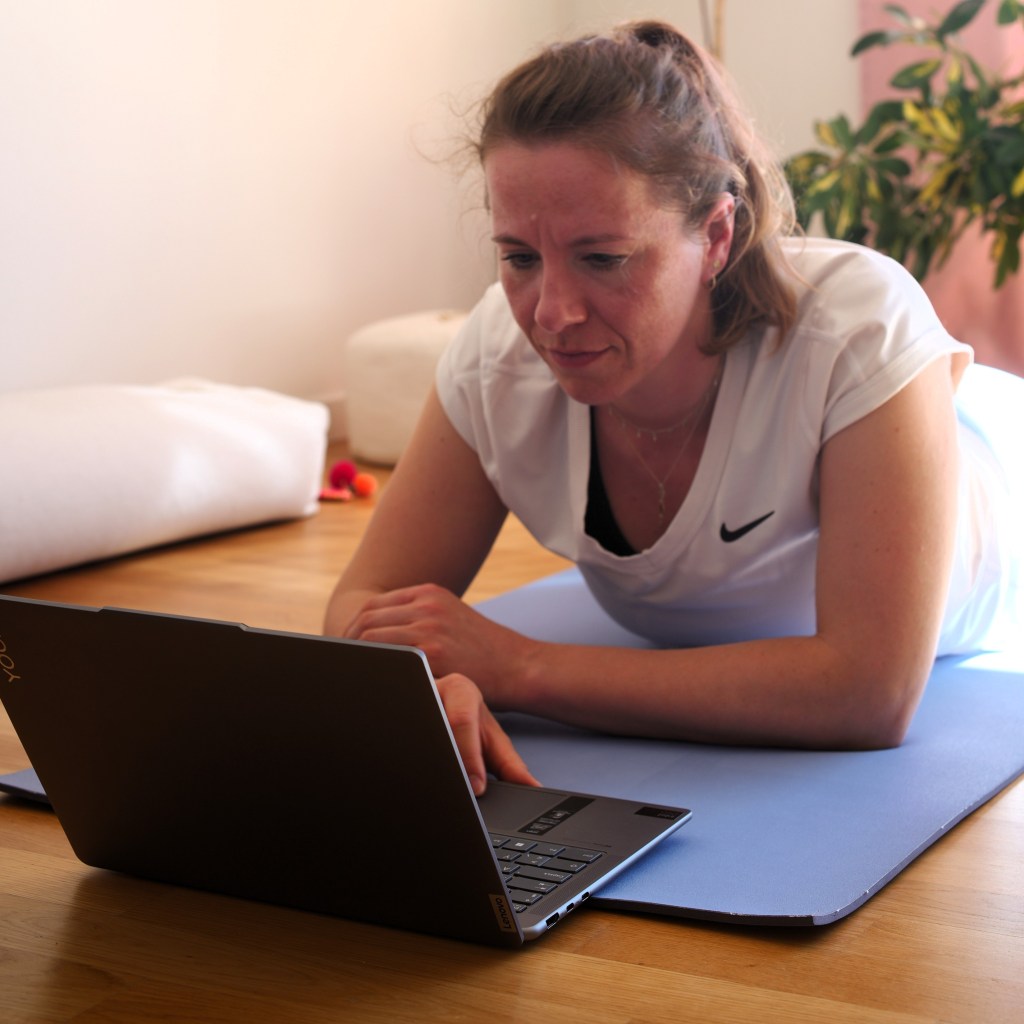
My zodiac sign is Libra, so I sometimes feel almost obliged to constantly pursue balance in my life. Ok, jokes aside.. but I really tend to look for this state in almost everything I do, even if I can’t always clearly explain why (apart from being a Libra, of course 🙂). Do you know what I mean? Let’s look at it more closely now.
Balance is often spoken about as if it is a fixed state we can arrive at and maintain. Something we achieve once we finally organise our lives well enough, optimise our routines or find the right combination of work, rest, movement and recovery. But in lived experience, especially in bodies that are active, ambitious and constantly engaged with the world, balance is actually not a destination per se. It is better understood as a continuous negotiation between our energy and awareness, that is always either shifting, responding or asking to be felt instead of controlled.
Burnout, in this sense, is not something that suddenly appears without warning, yet it is usually the result of a long process of subtle disconnection. It usually starts with a gradual drifting away from the body’s signals in favour of external demands. It becomes a slow prioritisation of output over sensation, thinking over feeling and doing over being. And so most people do not wake up one day in burnout – they arrive there through a series of small moments in which the internal rhythm was overridden just slightly too often. It might have been one too many skipped pauses, a disregarded signal of fatigue, a continued push through tension that was quietly asking for attention. And so over time, the system adapts to this pattern until it no longer differentiates between sustainable effort and depletion.
From a yogic perspective, this is simply a loss of communication. The body is always intelligent and it continuously communicates through breath, sensation, energy levels, digestion, sleep quality, emotional tone and mental clarity. But in modern life, these signals are often filtered through layers of interpretation, productivity logic and external expectation. We learn to trust calendars more than sensations, plans more than impulses, structure more than internal feedback. And slowly, the language of the body becomes quieter because it is not being listened to for so long. If you ever reached this state, you would know that balance then is about restoring communication and a process of re-establishing a relationship with the body’s intelligence so that energy can move in a way that is sustainable rather than depleting. In this sense, balance is responsive (not static) and actually requires awareness in real time, not just reflection after the fact.
In yoga philosophy, this is closely connected to the idea of prana – the life force that moves through the body and is influenced by how we live, breathe, move and perceive. When prana flows freely, there is a sense of clarity and steadiness even within activity. When it becomes blocked or scattered, we often experience symptoms that are not only physical but also mental and emotional: fatigue that rest does not resolve, restlessness without direction or a sense of being constantly “on” without feeling truly present in anything. Burnout is often the extreme expression of scattered or depleted prana. But long before that point, there are usually subtle signs from the body to return to balance, such as the feeling of needing more recovery after the same level of effort, a decrease in natural motivation or a sense that things require more force than before. These signals are very important communication points showing that your body is asking for a recalibration of how energy is being used at the current moment.
And from a movement perspective, balance is about changing the quality of engagement. For example: a yoga practice done in balance does not feel like either depletion or escape, but like presence. Sometimes that presence is dynamic and strong. Sometimes it is soft and restorative. What matters is not the external shape of the practice, but the internal relationship to it. Am I connected to myself while doing this or am I moving away from myself through it? This question becomes especially important for people who are naturally driven, creative or physically active, because for these systems, intensity can easily become normalised. High output begins to feel like baseline. Rest begins to feel like interruption. But the nervous system does not operate according to productivity logic but rather according to cycles of activation and recovery. Without recovery, activation eventually loses clarity and becomes strain. Thus burnout is often a collapse of clarity around energy, when the system is still functioning, but the signals are no longer aligned. This is why recovery alone is not always enough. What is needed is reconnection: a return to sensing what is actually present rather than what is expected. In practice, this can begin in very simple ways. Start noticing breath before responding to a request or feeling the body before committing to an activity. Also allowing pauses to exist without immediately filling them and observing the difference between genuine energy and stimulated energy. These are subtle shifts, but they change the direction of how life is lived.
And that is where the balance comes back, which in its deeper sense is not about preventing burnout as a final goal at all. Balance is about cultivating enough awareness that the system does not have to reach depletion in order to be heard, but also learning to recognise earlier and earlier signals of imbalance and responding with care rather than correction. This requires a different relationship to productivity itself – one that understands sustainability as part of performance rather than opposition to it. Because energy is not infinite in a linear sense, but it is renewable when it is respected. And when cycles are honoured, output becomes more stable, not less. In this way, balance becomes less about managing life and more about listening to it. It becomes an embodied sensitivity to rhythm. A willingness to adjust without judgment. A capacity to shift between effort and rest without losing connection to oneself. And perhaps this is the deeper distinction between balance and burnout: burnout is not just exhaustion – it is disconnection. Balance is not just rest – it is relationship. A relationship with the body that is ongoing, responsive and honest enough to notice when something is no longer sustainable. Because in the end, the question is not whether your life is demanding or calm, structured or chaotic, full or empty. The question is whether you are still in conversation with yourself within it.
This is exactly what I explore in my classes: learning how to stay in relationship with the body while life unfolds. So if this resonates with you, then you are welcome to explore my offerings. You can find them HERE.






Leave a Reply